News article

The European Water Framework Directive: what growers need to know about water management

Good water management doesn't start with the question, "Do I already need to comply with this?" It starts with the question, "Do I know what happens to my water?"

Horticulture | Smart greenhouse | Irrigation and fertigation

20 October 2026

Introduction

Water is one of the most important resources in horticulture. It not only supports crop growth but also plays a crucial role in the efficiency, sustainability, and continuity of a business. At the same time, increasing attention is being paid across Europe to water quality and responsible water use. Understanding where water comes from, how it is used, and where it ultimately ends up is therefore becoming increasingly important.

The European Water Framework Directive (WFD) places water quality high on the European agenda. But what does this directive mean in practice for horticultural businesses? And more importantly, how can insight into water flows help growers use water more efficiently and prepare for the future? 

What is the European Water Framework Directive? 

The European Water Framework Directive (WFD) has provided the European framework for protecting surface water and groundwater since 2000. 

The directive aims to protect the quality of Europe's waters, prevent further deterioration, and improve water bodies where necessary. It considers both the ecological and chemical quality of surface water, as well as the quality and availability of groundwater. 

One of the key principles of the WFD is the river basin approach. Water does not stop at regional or national borders. For this reason, water systems are assessed as a whole, even when they extend across multiple regions or countries. 

2027: an important milestone for Europe 

Within the current implementation of the WFD, 2027 marks an important milestone. In the Netherlands, the government has set a target for water quality objectives to be achieved by 2027. To contribute to this goal, the Dutch horticulture sector is working towards near-zero emissions by 2027, with a strong focus on reducing emissions of nutrients and crop protection products. 

Although specific regulations and enforcement differ between countries, the underlying trend can be seen across Europe: water quality and responsible water use are receiving increasing attention. This makes it an important moment for growers to gain insight into their water flows and processes, helping them prepare for both current and future requirements. 

However, this does not mean that the WFD ends after 2027. Water quality will remain a key focus of monitoring, measures, and future policy developments. 

For growers, the key question therefore is: do I understand which requirements apply to my business, and do I have sufficient insight into my water flows to manage them effectively? 

Does the WFD apply the same way across Europe? 

Although the WFD provides a European framework, its practical implementation differs from country to country.   

A grower in the Netherlands, for example, may face specific requirements related to emissions, registration, and reporting, while growers in other European countries may encounter different standards or measures. 

That is why it is important to understand: 

  • Which regulations apply to my business? 
  • Which water flows are part of my operation? 
  • Where are water or nutrients being lost? 
  • Which data do I need to provide for reporting or verification? 

The answers to these questions are local and business specific. However, one principle applies everywhere: effective water management starts with insight. 

Why is good water management relevant everywhere? 

Whether a specific WFD related obligation applies directly today or not, understanding your own water cycle is valuable for every horticultural business. By gaining insight and control over water flows, growers can better manage how water and nutrients are used throughout their operations. 

This creates opportunities to use water more efficiently, reuse suitable water flows more often, and maximize nutrient utilization. At the same time, losses, leaks, and deviations become visible more quickly, making it possible to take timely corrective action. Irrigation and water treatment can also be aligned more accurately with crop requirements and greenhouse conditions. 

Ultimately, good water management is about more than regulatory compliance. It helps growers make informed decisions, further optimize processes, and prepare for future developments. 

Where does water go within a greenhouse operation? 

To manage water effectively, you need insight into the entire water cycle. 

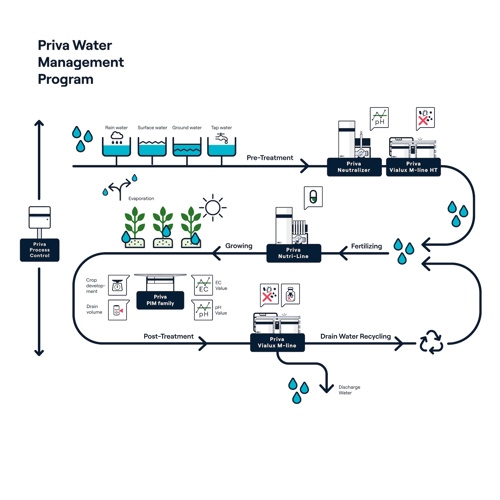
Water can follow many different routes within an operation. It may be collected and stored, used for irrigation, absorbed by the crop, or collected as drainwater. It can then be treated and reused within the growing process.

At the same time, unwanted water flows can occur, for example through leaks, overflow, unintended drainage, or discharge. 

Measurement is the foundation 

You can only effectively manage a water cycle when you understand what is happening. Sensors, flow meters, water counters, and measurements of parameters such as EC, pH, drainwater, and substrate conditions provide visibility into what is happening within the water system. 

However, data alone is not enough. The real value comes from turning data into actionable insights. Historical data helps identify patterns, dashboards provide visibility into water flows, and alarms highlight deviations before they develop into larger issues. By storing data over longer periods, it also becomes easier to understand how processes evolve over time. 

Measurements make water flows visible. Data helps you understand them. Insight enables you to take action. 

Guidelines for greenhouse water management

Download whitepaper

From insight to action  

Understanding water flows is an important first step. The real value arises when these insights are translated into practical actions within the growing process. 

One question lies at the heart of this: When does the crop actually need water, and how much? By aligning irrigation and fertilization strategies with real-time data and crop requirements, growers can manage irrigation, nutrient uptake, and drainage with greater precision. This helps improve the efficiency of water and nutrient use while reducing unnecessary losses. 

Automation and water treatment solutions support the stable and consistent execution of irrigation, dosing, recirculation, and water treatment processes. At the same time, dashboards, alarms, and trend analyses help identify deviations at an early stage. This provides greater control over water use, supports a more stable growing process, and creates a stronger foundation for informed decision-making. 

How can Priva support water management? 

Priva does not view the WFD as a standalone challenge, but as part of a broader shift toward data-driven and sustainable water management. Because regulations vary by country, region, and business situation, our focus is on supporting measurable, manageable, and transparent water management. 

1. Measure 

Priva helps growers gain continuous insight into irrigation, drainage, substrate conditions, and other relevant parameters. Solutions such as Priva Precision Irrigation Management (PIM) collect data on irrigation, drain, EC, pH, and substrate conditions. 

2. Decide 

Reliable data forms the foundation of effective irrigation and fertilization strategies. Priva systems such as Connext and Compact CC support process control and monitoring. Priva One brings climate, irrigation, crop performance, and operational data together in one integrated environment, helping growers align decisions more closely with crop needs. 
3. Execute 

Automation ensures stable and consistent execution of irrigation, dosing, recirculation, and water treatment processes. With Priva Nutri-Line, water and fertilizers can be dosed precisely, enabling irrigation strategies to be executed efficiently and under control. For water treatment and safe water reuse, Priva Vialux-Line offers a UV-C disinfection solution suitable for incoming water, drain water, and discharge water. 

4. Monitor 

Dashboards, alarms, and trend analyses help make deviations, losses, and potential risks visible at an earlier stage. These dashboards can be fully tailored to the specific situation of each business, allowing growers to monitor the parameters that matter most to their water management strategy. 

5. Demonstrate 

Historical data, logging, and process information can help provide insight into how water processes are managed and how these processes evolve over time. 

Looking beyond compliance  

The exact requirements may differ by country and situation, but the direction is clear: water will need to be managed more consciously and more carefully.   

This is why it makes sense to not wait until local regulations require action. Understanding your own water cycle, reducing losses, and being able to demonstrate how water is managed are developments that are relevant in every European market.   

Good water management does not start with the question, "Do I already need to comply with this?" It starts with the question, "Do I know what happens to my water?" 

By combining technology, data, and expertise, Priva helps horticultural businesses gain greater control over their water cycle, from irrigation and drainage to recirculation, treatment, and analysis. This makes it easier to use water more efficiently, reduce emission risks, and prepare for future developments. 

Contact

Discover how Priva can help you gain more insight and control over your water management.

Juan Gonzalez

Account Manager Horticulture

Juan Gonzalez