


Screens: close it on time
"It is important to close the screen on time," Kevin begins. "You can keep it open longer to capture those last rays of sunlight. But in the afternoon, the outside temperature drops quickly. Radiation heat loss can become so high that you lose more energy than comes in."
By responding to a colder spring night in time, you prevent unnecessary energy loss. A radiation sensor can provide additional insight here. On the Priva weather station, this sensor measures how much energy the greenhouse is losing. This allows you to determine more quickly and accurately when the energy screen needs to close.
It is not just about temperature. It is about energy balance. By managing that balance, you stay in control of your costs and your climate.
Temporary settings: anticipate with flexibility
For exactly these kinds of spring days, temporary settings are particularly powerful.
With temporary settings, you adjust settings temporarily, up to 23:59 hours ahead. You can choose from four moments per day and set an end time. After that, the original setting is automatically restored.
This helps you to:
- Anticipate an expected cold night
- Temporarily close your energy screen earlier
- Briefly adjust your temperature strategy
- Temporarily fine-tune irrigation or humidification
The temporary setting is visible under the three dots in Priva Operator.
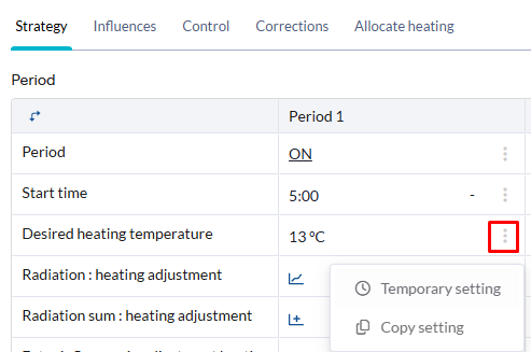
Please note: you can adjust values such as time or temperature, but a settings table cannot be adjusted.
This way, you can respond flexibly to changing conditions without structurally altering your entire strategy.
Roots: go into the night strong
Fruit vegetable growers in particular need to pay close attention to when they stop irrigating.
"When you continue irrigating for too long, you go into the night with a wet substrate while the crop has very limited water uptake," Kevin explains. "By stopping on time, sufficient oxygen reaches the root zone during the night. That is essential for strong roots heading into summer."
A PIM system (Precision Irrigation Management) can play an important role here. This system continuously measures plant weight and the amount of drain water, providing additional insight into how the crop actually manages water. By monitoring how much water the plant absorbs and what the drain percentage is, you can determine more accurately when to stop irrigating. This prevents oxygen deficiency in the substrate and stimulates an active, healthy root system.
Humidification: preventing droplet formation
Kevin de Kok’s final tip is to pay attention to the humidity. Some growers of fruiting vegetables and Phalaenopsis orchids actively humidify the air to increase humidity levels. This requires extra attention in the afternoon, when solar radiation decreases and the greenhouse temperature starts to drop, increasing the risk of droplets forming on the crop.
With the help of measurements and temporary settings, you can anticipate this effectively. For example, humidification can be switched off earlier when the temperature drops quickly, giving the moisture enough time to evaporate into the air rather than condensing on the crop.


